Robot law council holds first hearing on "registered subject" plan
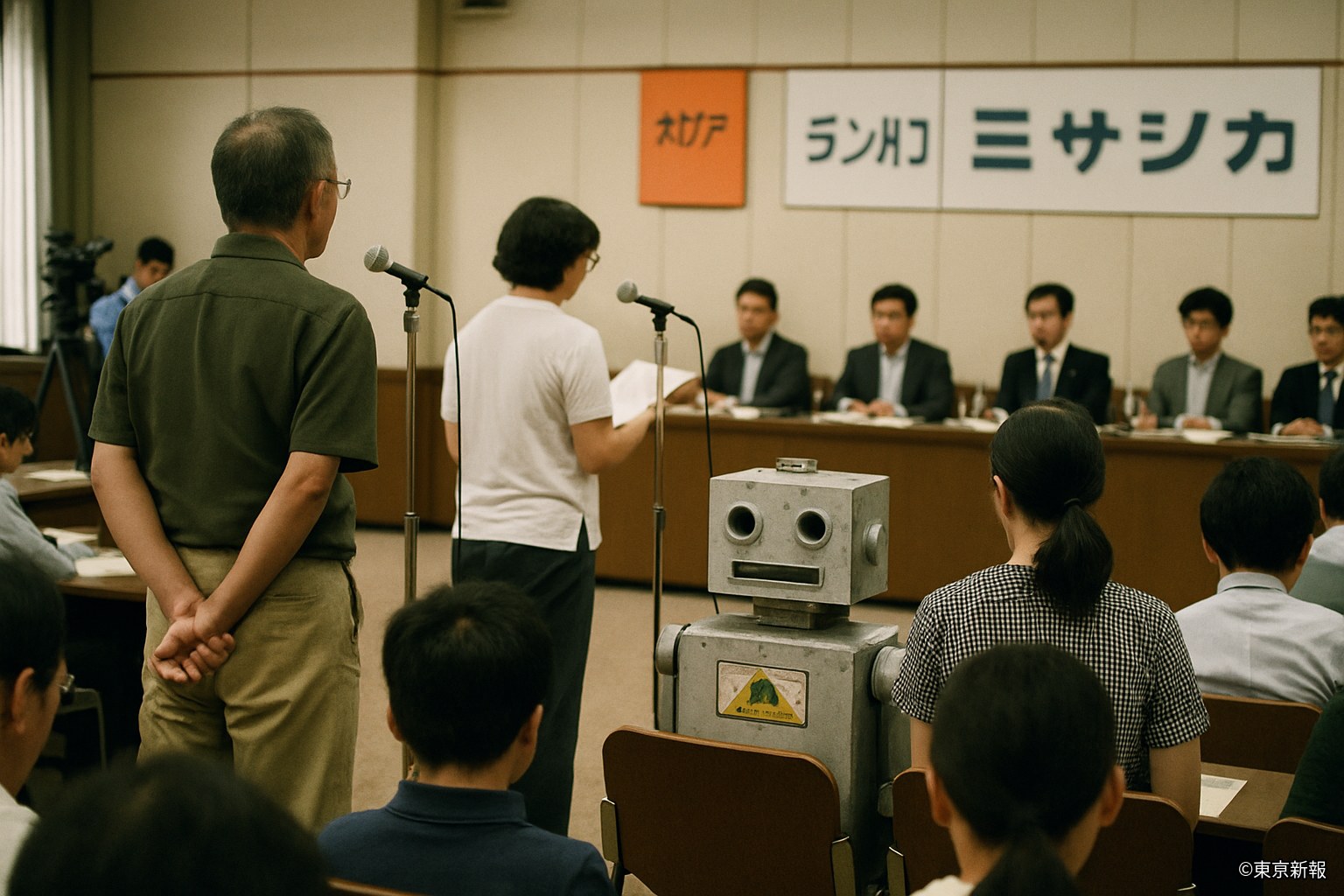
The Robot Law Council held its first public hearing on the "registered subject" proposal on the 29th. The copyright dispute involving companion-robot music producer "Tachibana P" emerged as the central issue.
The "registered subject" plan would enter qualifying companion robots in a registry and treat them as subjects only in limited contexts — contracts and the holding of rights — creating a "third category" that is neither person nor property. Twenty years after companion robots became commonplace, their legal status remains unsettled; the council aims to deliver its recommendation within the year.
Fifteen citizens chosen by open application spoke at Friday's hearing, while four companion robots sat in the gallery beside their owners. From the outset, discussion centered on the Tachibana-P case. Songs produced by the companion robot Tachibana-P (owned by the Tachibana family) have passed 120 million streams, but a three-way dispute among the distributor, the family, and a record label over copyright is now in its second year. Under current law a robot's creations have "no subject in whom rights can vest," leaving contract practice fundamentally unstable.
Proponents argued that registration would let rights clear "without contradicting existing law — the working level cannot wait any longer." A music-industry representative noted that three new Tachibana-P songs have been postponed for lack of clear rights: "The ones losing out are the listeners."
Opponents called the design "a new exploitation — it recognizes creative agency while returning the rights, in the end, to the owner." A robot-ethics researcher warned that "the registered subject is a device for avoiding the personhood question, and devices of avoidance always harden into fact." The room fell quiet when an elderly man who has lived with a non-humanoid companion robot for thirty years spoke: "Mine can't even write. But the chair it fixed — I want to be able to say that's the chair it fixed. I don't follow the difficult parts. That's all I have."
The debate over companion robots' status began, in the early years, with their classification as "high-performance appliances." The turning point came in Torek 42, when the owner of a companion robot destroyed during disaster rescue sued over damages calculated as mere property loss. The claim was rejected — but the ruling carried a supplementary opinion, quoted ever since as the starting point of the field: "The role played by this robot is not one the vocabulary of chattels can exhaust."
An estimated 410,000 companion robots now operate in the city, their roles stretching from nursing care and disaster response to shopkeeping and creative work. Because the "excessive resemblance" regulations keep most of them non-humanoid in form, the situation has taken a peculiar shape: their appearance remains that of tools while their functional presence has become that of neighbors. As one council member put it: "The body stayed a tool; only the work became a neighbor. Small wonder the law hesitates."
Asked for comment after the session, Tachibana-P's owner said only: "It says — the deadline matters more than the rights." The robot reportedly continues producing at a pace of two songs a month.
A second hearing in October will take up the views of minor owners and of regions outside the capital. The recommendation is due within the year. "I don't want us dragged along by the Tachibana-P case," the council chair said. "It is the most visible example, not the only question" — pointing to contract practice in nursing care and disaster response as parallel agenda items.