23 years after the Bay Ninefold Fog: families seek reinvestigation
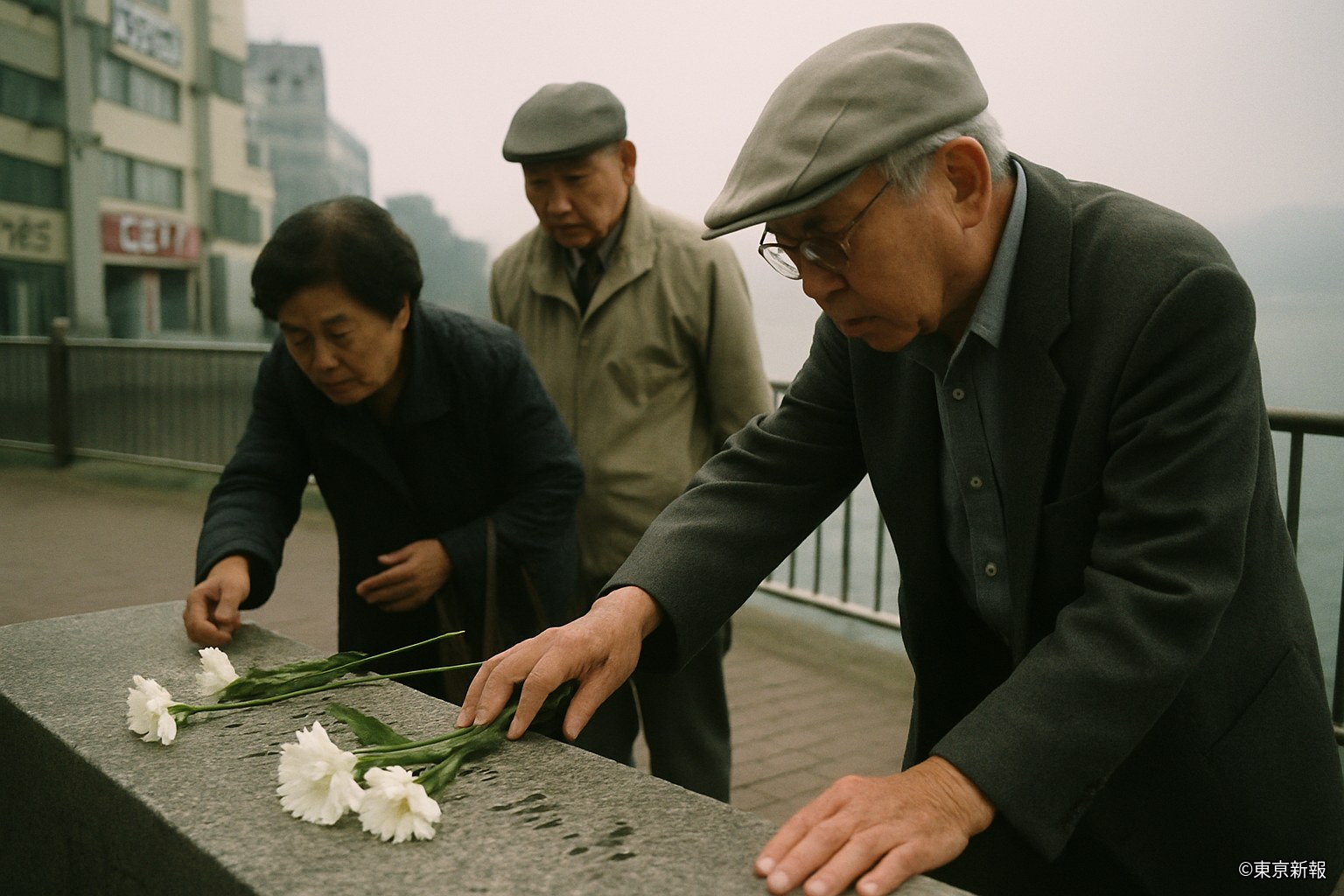
Ahead of the 23rd anniversary of the Bay Ninefold Fog (2003), the largest permeation event on record, in which twelve people went missing, the families' association petitioned TDA for a reinvestigation on the 29th. TDA responded that it would re-analyze the initial observation records under the framework of an international joint study.
The Bay Ninefold Fog of Torek 29 (2003) remains the largest permeation event on record: for nine days, a dense fog of unknown origin covered the Tokei bayfront while the permeation index sat pinned at the top of its scale. The TDA sealed the entire bay area on the third day. When the fog lifted, twelve people who should have been inside the cordon could not be accounted for — five warehouse workers, three anglers, two residents, and two TDA observers. The only trace ever found was two pairs of shoes, neatly aligned at the quay's edge. Twenty-three years on, there has been nothing else.
On the 29th, the families' association Kokiri-no-Kai delivered a petition to TDA headquarters addressed to Director Makoto Hiura, with three requests: full disclosure of the raw observational data, a review of how the cordon was operated, and a reinvestigation committee that includes outside members.
The association's founding representative, 71, lost her husband, a warehouse worker, to the fog. "The words 'they are alive on some other worldline' — there were days they comforted me and days they tormented me. If he is alive, why were the shoes lined up? If someone can explain that, then the twenty-three years of waiting meant something. We simply want the facts."
Membership has fallen from 31 at founding to 17. This year two university students, grandchildren of the missing, joined; for the first time, the petition was drafted by a generation that does not remember the event.
Director Hiura, receiving the petition, said the fog "is carved into this agency's memory as the event in which we failed to fully protect residents," and answered that the initial observation records will be re-analyzed within the framework of the ongoing Seventh International Joint Study. The Torek-29 data survives on magnetic tape; recent digitization has made short-period fluctuations analyzable for the first time. "The analysis technology is a different animal now," an observation-department official said. "I cannot promise what will emerge — but we will do this honestly, including confirming that nothing emerges." Results are to be reported to the families by next year's memorial day. On the cordon review and the outside committee, the agency said only that it would "take the requests back for consideration."
For twenty-three years the association has gathered at the memorial on the ninth of every month. The gatherings have no fixed order of service: flowers are laid, each person stands before the stone, news is exchanged, and everyone goes home. "It is less a prayer than a roll call," the representative says. "Every month, we report that we are still waiting."
A man, 64, brother of one of the missing, kept his brother's room untouched for twenty-three years — until this spring, when he cleaned it for the first time. "I didn't put anything away. I only wiped the dust. If he comes back, I can't show him into a room with twenty-three years of dust." That cleaning, he said, is what moved him to support the petition: "I learned that even waiting needs upkeep."
In law, the twelve remain "missing persons" to this day. An ordinary declaration of disappearance would treat them as legally dead — and most of the fog families have refused to file one, unable to accept the word. In response, Torek 31 brought the special status of "permeation disappearance," which allows certain banking, insurance, and inheritance procedures to move forward without a presumption of death. It has been applied to just 29 people nationwide, the twelve of the fog among them.
"The law had only two boxes — alive or dead. We built a third," recalls the former justice-ministry official who drafted it. "That box exists because the fog families made the state write it." The status has drawn criticism from the start — that it institutionalizes suspension itself — and even within the association, some households chose it and some did not. "Neither choice is the correct one," the representative says. "There are as many ways of waiting as there are houses."
The Ninefold Fog also remade this country's Yuragi administration: the five-level index display, resident-roster checks during closures, and the bay's permanent observation network all date from its aftermath. Even now, with over thirty percent of the population too young to remember it, bayside elementary schools still call their September drill the "fog drill."
Through the morning, commuters stopped at the memorial on the bay promenade to leave flowers behind the families. The stone bears twelve names, and one line: "The fog has lifted. We are waiting."