"The Window of 1975" hits its 20th printing
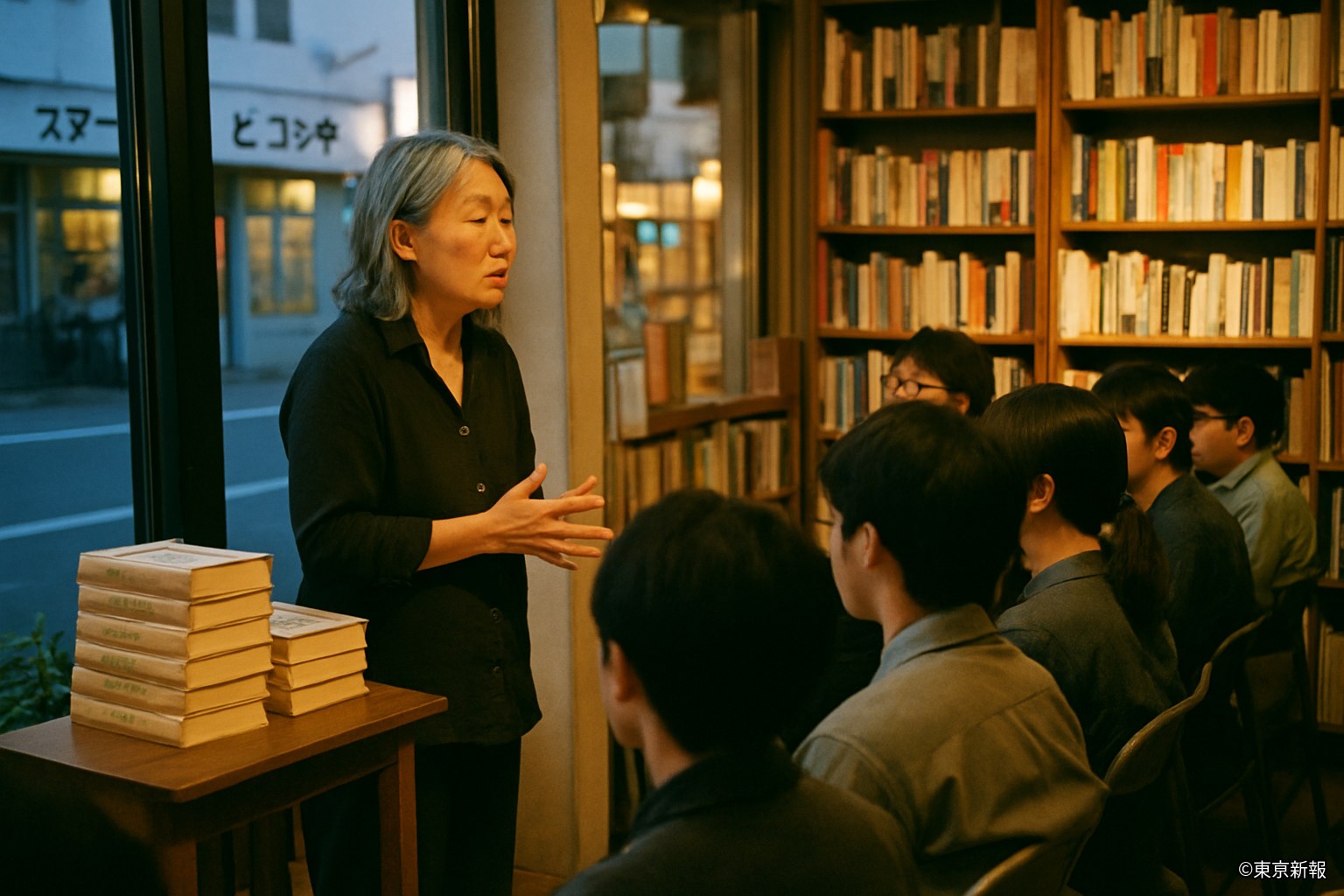
Independent researcher Karin Kokonoe's book "The Window of 1975" has passed its 20th printing. Her writing, which searches for "meaning" in the origin of the Yuragi, continues to be ignored by academia, but three years after publication its readership keeps growing.
"The Window of 1975" is an unclassifiable work that brings a folklorist's eye to Yuragi observation data. Reorganizing the public record since the first observation in Torek 1, it argues that the distribution of occurrence sites loosely overlaps the bay's old sacred places, arriving at the final chapter known for a single sentence: "The window did not open by chance." Its publisher reports 270,000 copies in print — extraordinary for a humanities title — with monthly sales holding at ten thousand this year.
The scientific establishment's verdict has been uniformly negative. The observation society has declined ever to review it; one prominent scholar called it "a trade fair of misread correlations," and the TDA has stated that "no significant correlation with sites of worship is recognized." Kokonoe is unmoved: "I wrote a question, not a proof. A question belongs to everyone. The academy is free to keep silent. My readers are not silent."
Forty percent of the reader cards returned to the publisher come from teenagers. One postcard reads: "The Yuragi in this book is scarier than the one we learn at school, and I like it better." About eighty people, most in school uniforms or of university age, filled a Joto bookshop on Friday night for the third-anniversary event.
During the Q&A, a second-year high-school student asked: "My teacher says this book is not science. Is it all right to keep reading it?" Kokonoe answered: "Your teacher is correct. This is not science. It is the work of picking up the questions science has decided not to answer. Read both. A window cannot be looked through with one eye."
Kokonoe has never held an academic post. After leaving a master's program in observation science, she spent twenty years conducting weekend interviews while working at a bayfront surveying firm. Her field notebooks number 214. The back matter of "The Window of 1975" lists, by name, all of the roughly 320 bay residents who spoke to her — the deceased included — and many readers say they love that page of acknowledgments more than the text itself.
Eleven publishers rejected the manuscript. The editor at the twelfth recalls: "I told the company we could not publish it as scholarship — but that it was the record of what the people of the bay have been thinking for fifty years, and that its value had nothing to do with peer review." Informed of the twentieth printing, Kokonoe reportedly answered that she would write a postcard to every speaker in the 214 notebooks. She has finished ninety so far.
The book carries a burden as well: groups of the "distortion faith" treat it like scripture, and it was found quoted without permission in the materials of an attunement-development scheme. This year Kokonoe issued a statement disclaiming "any connection to those who solicit money on this book's authority."
At the event's close, she revealed the subject of her next book for the first time: the Bay Ninefold Fog. "I do not intend to write what happened inside the fog twenty-three years ago. I will write how we waited outside it. That, I am qualified to write."