'We're Keeping This Safe' — The Words That Fill the Guestbook for Unclaimed Drift Objects
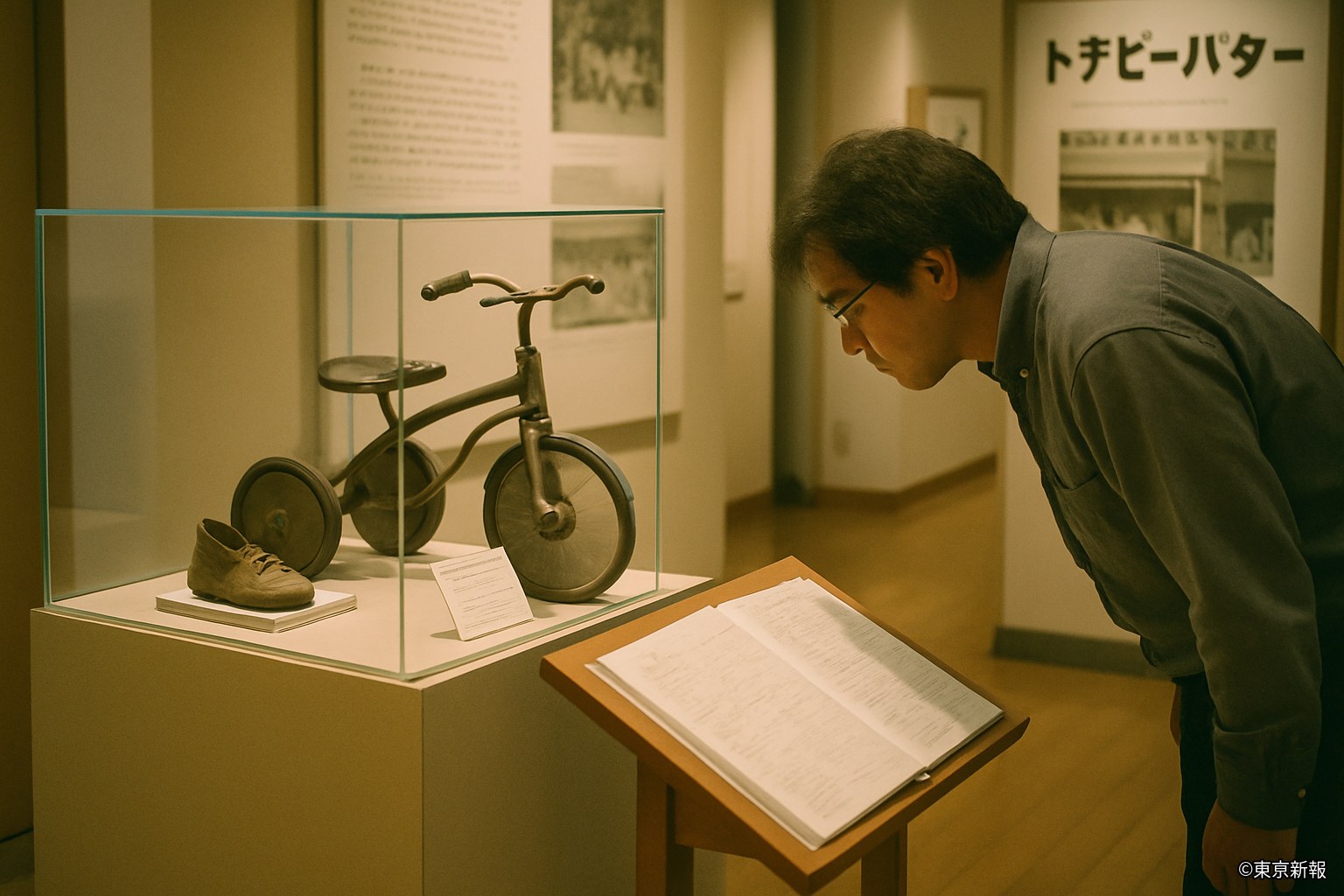
The single child's shoe previously reported as Lineage 122, registered on Sept. 21, is on temporary display this week — while it awaits full appraisal — in a corner of the municipal Drift Object Museum's exhibit, 'Luggage Whose Owner Never Comes.' The household items of Lineage 31, running from a tricycle through a pot, a wooden box, a boot, and now this shoe, have come to be called around town 'the lineage with a strong sense of everyday life,' or simply 'the neighboring world.' Facing objects whose owners will never step forward, visitors tend to write down words that fall into a surprisingly consistent pattern.
A new glass case appeared this week in a corner of the municipal Drift Object Museum's permanent exhibit, "Luggage Whose Owner Never Comes," in Kameido. The previously reported single child's shoe — Lineage 122 — is on temporary display there, on the condition it be pulled once full appraisal begins in earnest. Beside it sits the tricycle, the very first item registered to the previously reported Lineage 31, found in Kameido in the ninth year of the Permeation Era. Both are spoken of as belonging to "the lineage with a strong sense of everyday life," yet officially registered as distinct lineages by isotope ratio — a pairing, separated only by a pane of glass, that feels distinctly this town's own.
As previously reported, the Fukagawa district has long shown a tendency toward drifting household items, giving rise among researchers to the informal term "Fukagawa-type" drift. It is recorded as the ninth such case; the oldest was a chair found in the street, and the largest a boat-shaped structure found in the 44th year of the Permeation Era. "Every item called Fukagawa-type carries traces that someone once used it," a museum curator said. "Broken here, worn there. I think that's what makes people respond to them differently than they do to other lineages."
Fukagawa's neighborhood associations have a custom of burying a metal plate at the spot where a drift object was found. As previously reported, since the objects themselves become state property and are carried off, the idea is to leave behind at least the memory of the place. "Burying it is only a mark that something happened here," said an unnamed association officer in his sixties. "It isn't a plaque explaining what."
Visitors are free to write in the museum's guestbook after viewing the exhibit, and the curator says one phrase recurs again and again, offered in visitors' own words: "We're keeping this safe." "People tend to write it that way — keeping it safe — rather than something like 'until the owner is found,'" the curator said. "No one suggested it. It's strange to us too, watching the same words pile up on their own."
As previously reported, the alliance of ritual organizations has been proposing that harmless household items be treated in a manner closer to a memorial rite, part of an ongoing debate over revisiting the blanket rule of state ownership. While the museum says it has no direct role in that debate, it offered this: "If display turns out to be another way of facing these things — neither memorial rite nor ownership — I think that has its own meaning."
Of the shoe now on display, the curator said, "We're displaying it in a way that leaves open the chance its match will turn up. Being only one of a pair is simply this shoe's present state." As previously reported, the woman who found it said that finding only one, somehow, made her imagine the person who lost it, leaving her a little wistful — a feeling that seems to be shared by many who come through the museum.
Standing between the tricycle and the shoe, this reporter found it hard to move on for a while. Two items that science, by isotope ratio, places on separate world lines somehow share the same memory in their stitching. At the line between what can be known and what can't, this town buries metal plates and keeps writing "we're keeping this safe" in a guestbook. That, this reporter suspects, is simply how this town has learned to live alongside what has no answer.
The shoe's temporary display is expected to continue for several months, until full appraisal begins.