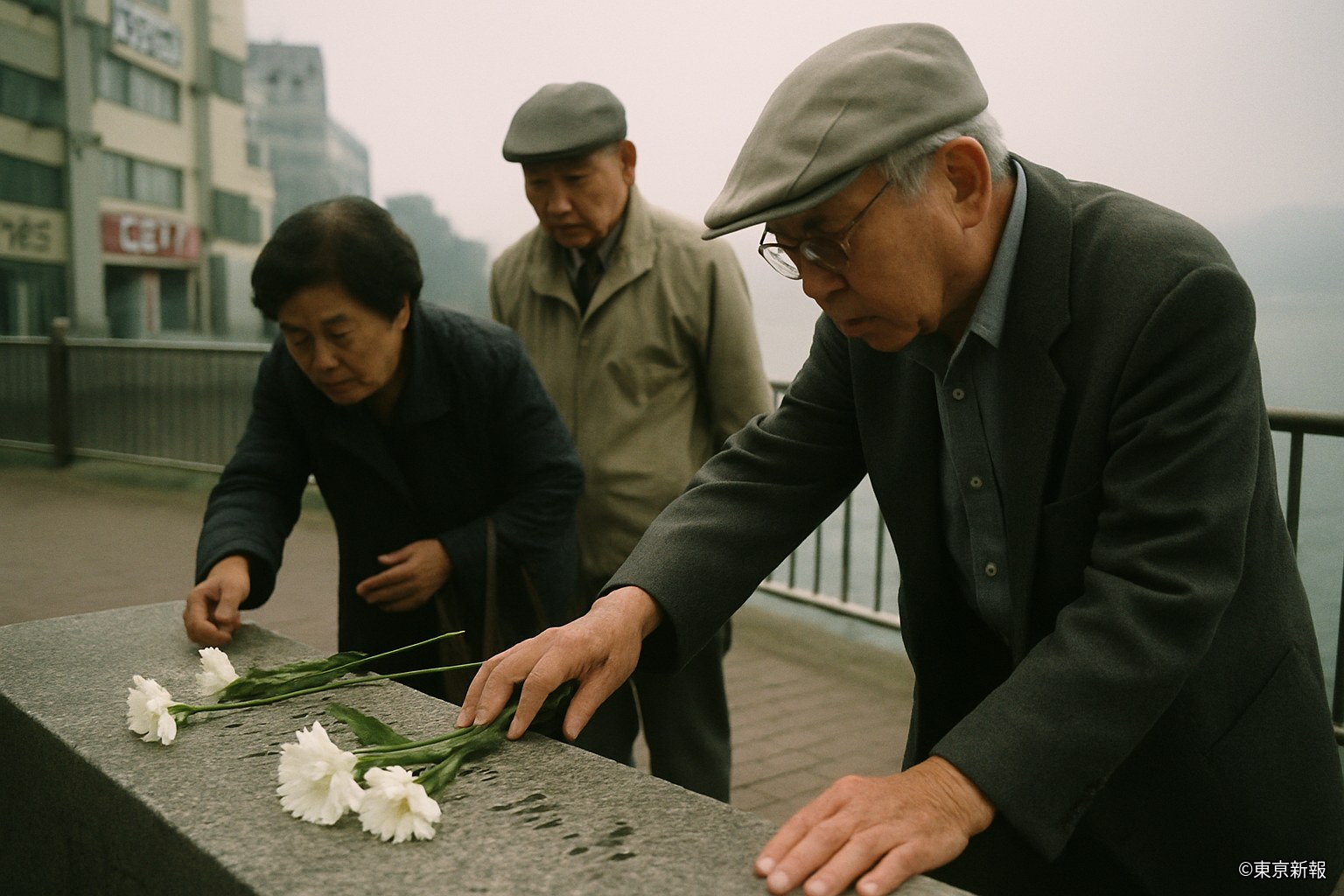
"Lullaby of the Shore" nears first public performance
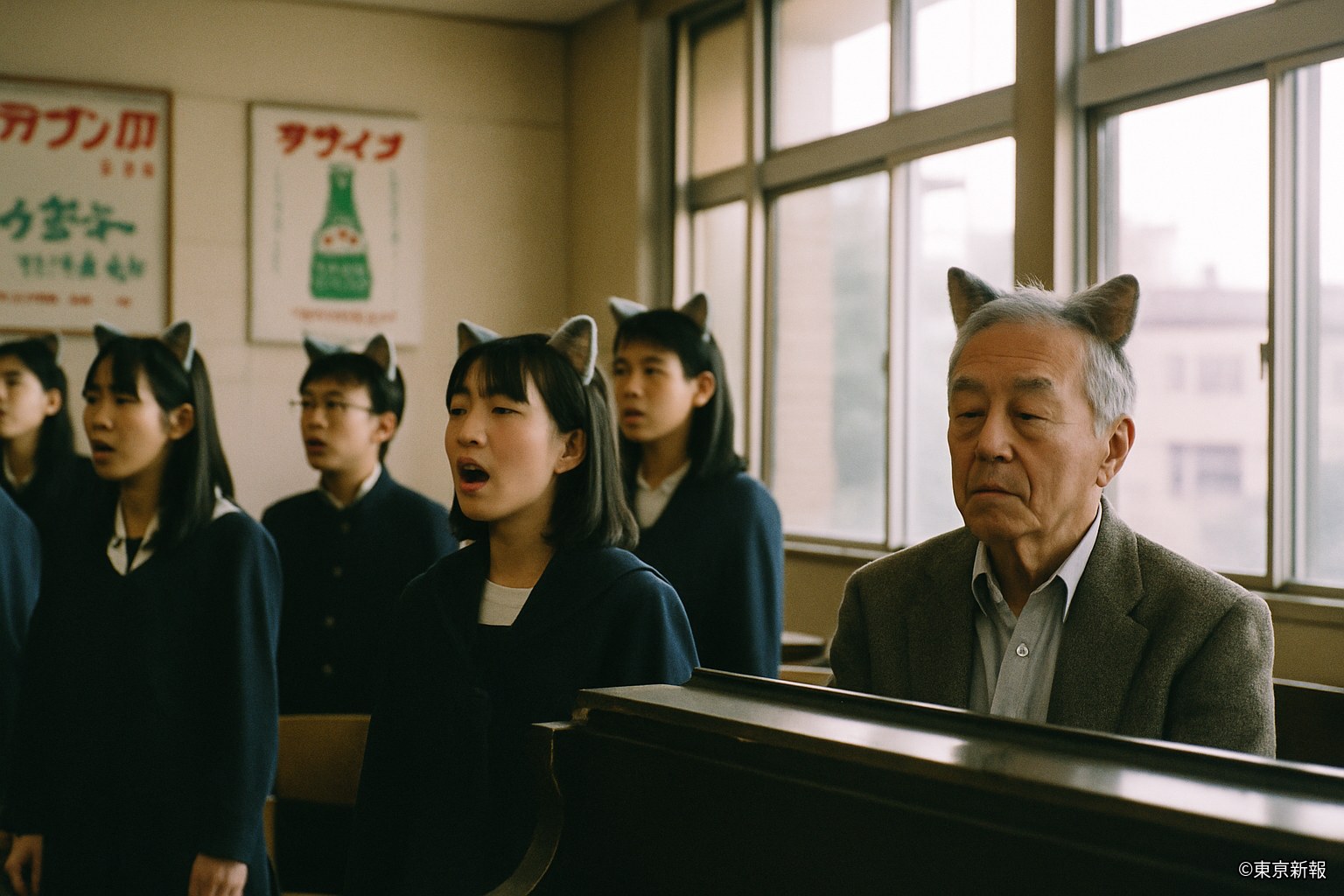
"The Shore Lullaby," transcribed into notation for the first time in half a century, will be sung in public for the first time at the September 7 Arrival Remembrance Day gathering. On the 29th, a junior-high choir of largely half-Drifter students held a final rehearsal, inviting Ushio Kishiura, 74, who transcribed the song.
The "Lullaby of the Shore" is believed to have been sung in the bayside internment shelters in the first year of the Torek era (1975), by first-generation Drifters putting their children to sleep in the days after the mass arrival. It is sung in the language of their home worldline, and even among the first generation there is no agreement on the precise meaning of the words. Interviews have established only that it contains words that seem to mean "sea," "window," and "the way home."
For half a century the song had no score. The first generation refused transcription, saying that "if it is written on paper, the song can no longer go home." The turning point came three years ago, when Ushio Kishiura, 74, one of its last carriers, volunteered to transcribe it himself: "If I die, the song dies with me. That is the same as never going home." Working with the city's intangible-heritage survey team for two years, he recorded all thirteen verses in phonetic notation.
Wednesday's rehearsal brought together 28 half-Drifter students, mostly from Bayside Third Junior High, and nine students of non-Drifter families who joined by open call. Mr. Kishiura sat on a stool beside the piano and corrected the pronunciation one detail at a time — a sound rolled at the back of the throat, a word-ending that dissolves into breath. "Pronunciation cannot be taught on paper. It is taught with the face," he repeated, pointing to the students' mouths.
The language of his home worldline no longer has a dictionary. A third-year boy, 15, said: "I don't know what the words mean, but at the second verse I always see my grandmother's face. I love that it happens without the meaning." The music teacher who leads the choir stopped handing out phonetic sheets partway through the year: "The moment they see the kana, it becomes the sounds of Hinokuni. Passing it ear to mouth turned out to be more accurate."
Alongside the transcription, the city's survey team attempted a linguistic record of the lyrics. They completed a phoneme inventory, but semantic identification stopped at the three conjectured words — sea, window, the way home. "The meanings of a language with no living translator cannot, in principle, be fixed," the team's linguist says. "What we can do is preserve the sounds exactly, and record our conjectures as conjectures." The report deliberately avoids the term "meaning unknown" in favor of "meaning undetermined": "Unknown is a dead end. Undetermined means we are still on the way."
At the September 7 gathering, no translation will be read before the singing. "It is not that we cannot translate and therefore do not," the organizing committee explains. "The first generation chose to hand the song on untranslated."
Not everyone has made peace with the score. A first-generation woman, 79, who opposed the transcription to the end, told this paper: "I don't blame Ushio. But I always thought of that song as existing in as many copies as the people who remember it. A song on paper is a slightly different song." She will attend on the 7th all the same: "Even as a different song, I will know it when I hear it. I will know it is the song of the way home."
Mr. Kishiura has not donated the original score to the city. It is kept in a drawer of his family altar, with only a copy in the municipal archive. "The city's stacks are too grand. That song belongs next to the tools of daily life." The original, he has decided, will be made public "after I die."
The choir has rehearsed twice a week since last October — more than seventy sessions. Applications jumped from an initial twelve after the wall-racing athlete Rui Migiwajima mentioned on a stream that "my little sister is singing, so I'll be there," forcing an unprecedented audition. "Any motive will do," the music teacher laughed. "A song doesn't choose its doorways."
At the end of the rehearsal, Mr. Kishiura sang all thirteen verses through with the students, then sat for a long moment with his eyes closed.
"When I began the transcription, I said the people who could sing this song to the end numbered four, counting myself. I correct that. Today, thirty-seven more," he said. "The first generation can be counted on our hands now. But the song is becoming uncountable. Today I decided that this is as it should be."
The first public performance opens the "Gathering of the Fifty-First Year," the noon ceremony at Kishihama Park on the bayfront on September 7, Drift Memorial Day. Attendance is open to all. The city has invited 121 first-generation Drifters — about half the number of a decade ago — and the ceremony will be relayed to three care facilities in the city.
Mr. Kishiura will not be on stage. "I will listen from the last row. Once you send a song off, it is no longer yours."