Window 3's 'the Watcher' Responds to a Deliberate Signal — Survey Division Confirms a Match Three Times Running
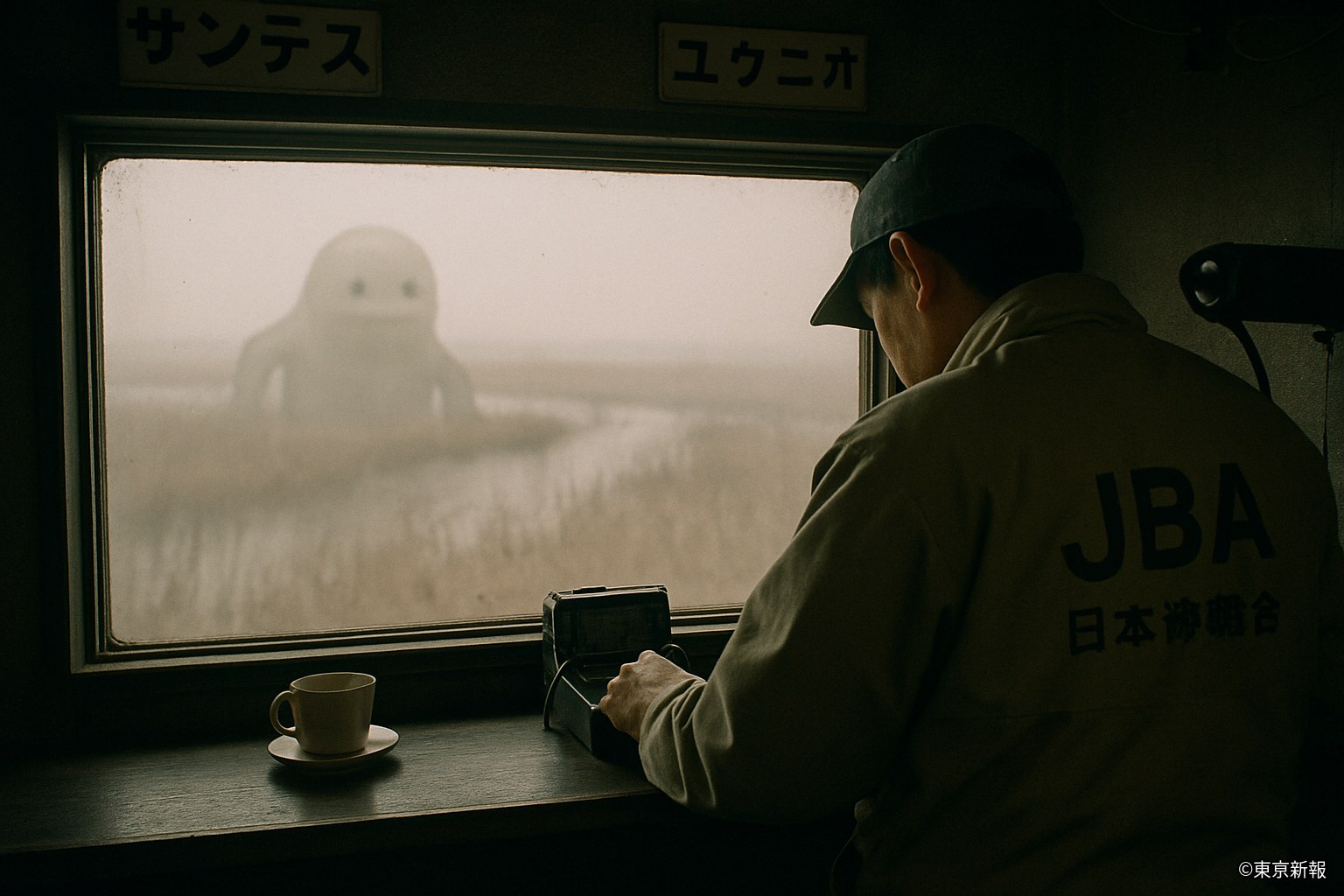
The TDA's Dimensional Survey Division announced on the 14th that during an observation at Window 3, 'the Slime Marsh,' late on the night of the 13th, it sent its first-ever deliberate signal — flashing the observation room's lighting in a fixed rhythm three times — and the previously reported individual 'the Watcher' (officially numbered 88-C) changed its body color in nearly the same rhythm, three times in a row. Past 'weak correlations' were responses to unconscious movement on this side; this time the match followed an intentional signal, prompting the division to say for the first time that it is 'hard to call it coincidence.' It maintains its cautious position that this does not prove communication.
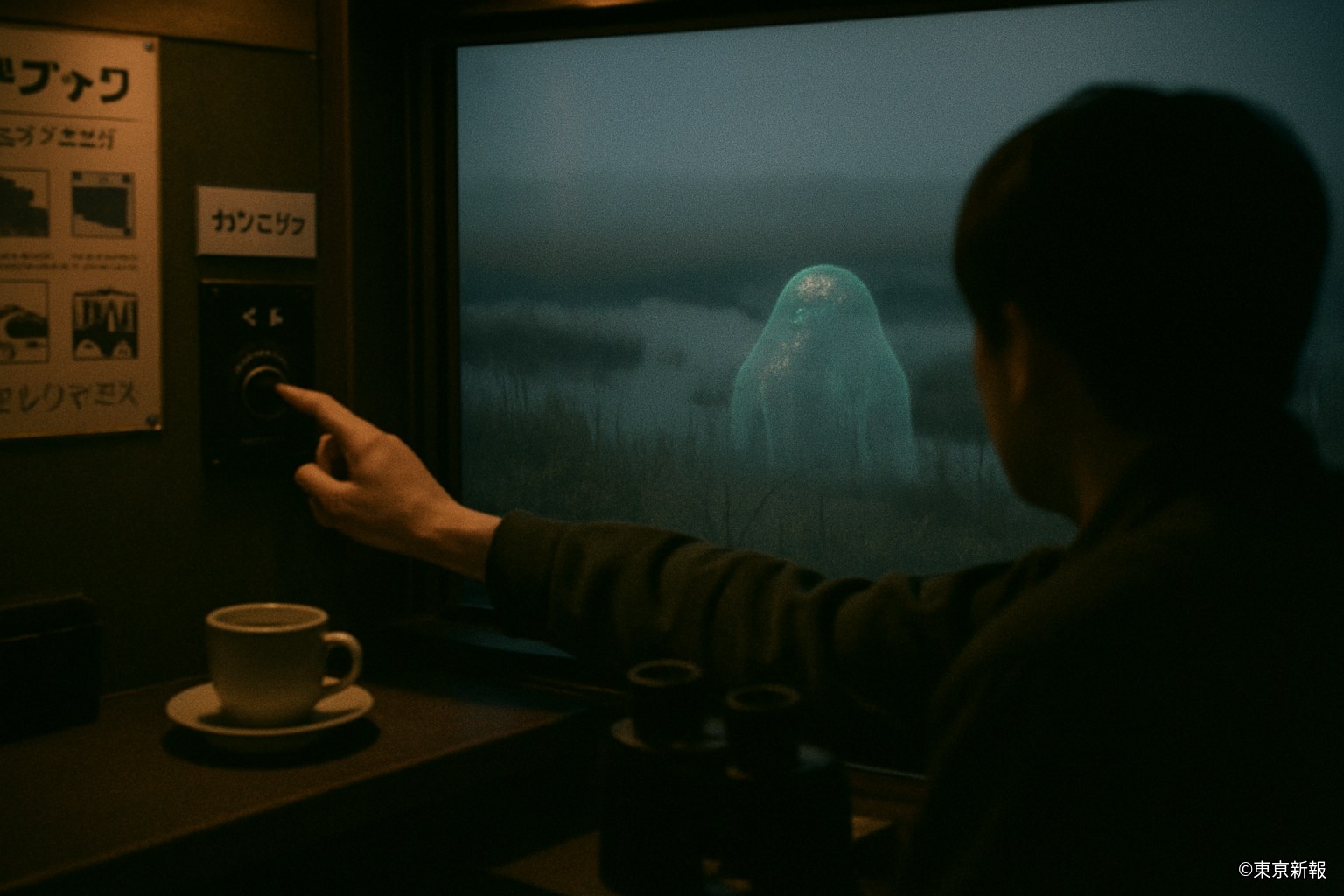
Window 3, "the Slime Marsh," opened for roughly 100 minutes starting shortly after 11 p.m. on the 13th. According to the Dimensional Survey Division, about thirty minutes into the opening a window keeper confirmed that the previously reported individual known as "the Watcher" (officially numbered 88-C) had appeared in its usual spot in front of the window, and then, following a procedure decided in advance, flashed the observation room's lighting in a rhythm of "two seconds on, one second off," repeated three times. Past observations had only counted the creature's reactions to the window keepers' ordinary movements — adjusting recording equipment, setting down a teacup — but this marked the first time a signal was deliberately designed and sent for the purpose of observation.
"Until now, we could only guess whether the other side was aware of us, by inferring it from reactions to our own unconscious movement," an official explained. "What's different this time is that we reached out first."
In response to the flashing light, the Watcher's body color dimmed slightly just after the first flash, returning to normal after about two seconds. The same pattern recurred after the second and third flashes, with the time from the start of each color change to its return falling within a range of 1.8 to 2.3 seconds all three times — closely overlapping the lighting intervals. The division's analysis lead said, "Getting the same reaction at the same interval three times in a row is the most tightly aligned data we've seen even among the 'weak correlations' reported so far. It's hard to say the odds of three coincidental matches in a row are statistically high."
The same official added a caveat: "Alignment and judging that the Watcher is 'responding' are two different things. We still can't rule out, from this data alone, an explanation in which the creature simply has a physiological tendency to synchronize with a simple environmental change like light and dark. Whether the other side recognizes our signal as a signal and sends something back, or its body is simply reacting in unison to a stimulus of light and dark, is something we can't yet tell apart with what we have."
As previously reported, at Window 5, "the Sword Country," people in the market have been confirmed raising talisman-like objects toward the window across three consecutive openings, and the division has officially acknowledged "signs that the other side is aware of the window." Asked about today's Window 3 result, the official said, "The two cases may look similar in character, but Window 5 involves a human-shaped presence repeating a motion plainly visible to the human eye. Window 3 involves body color — an ambiguous indicator — in a creature whose capacity for intentional versus physiological response isn't even established yet. Placing them on the same rung would be premature." The division has therefore declined to upgrade Window 3's assessment to "signs of awareness," and said it will keep Windows 1 and 5 as its main focus while continuing roughly weekly fixed-point observation at Window 3.
The secretariat of the previously reported outside-experts review panel, chaired by Etsuko Kajiura, said it would move quickly to add today's result to the agenda for its next meeting. Kajiura told this paper, "This first step — a response to a deliberate signal — carries weight. But rushing to a conclusion on a first step would undo the caution we've built up so far. I want to first confirm whether the same thing happens with the next signal test."
The window keeper who sent the signal, speaking on condition of anonymity, recalled, "My hand shook pressing the button, which isn't like me. Sending a signal hoping something might come back is a completely different weight from sending one just to keep a record." They added, "The moment I saw the Watcher move in the same rhythm, I made a sound without meaning to. But being able to properly explain why I made that sound — I think that's still a long way off."
The division plans to repeat the same signal test across several more openings to check for reproducibility, a process expected to take several weeks.
Window 3 has focused observation on a translucent, slime-like creature since coming into service in June 2025. A weak statistical correlation between its color changes and the observation room's lighting and movement was first confirmed in August, and late on the night of September 18 the Watcher approached closest ever to the boundary glass, its color fading to near-colorlessness for several seconds before flickering faintly. No comparable approach was confirmed afterward, and the division has treated the September 18 event as an exception. Today's signal test, the division says, was the first it has carried out after securing internal ethics-committee approval, on the strength of the accumulated weak-correlation data.
"There was caution even about stimulating the Watcher at all," an official said. "We judged that something as modest as a flashing light was unlikely to affect the creature's life or ecology on the other side, but we intend to keep the scale and frequency of any such tests to a minimum going forward." Window 3's data is also shared under the 7th International Joint Study, and researchers from the Hindu Federation, one of the study's co-chairing nations, may push harder for formal joint analysis to begin in light of today's result. The division still calls that "premature," though an official conceded, "Growing international interest is probably unavoidable."
Toru Yuzuki, 31, the technician who analyzes the "procession of lights" and the "sound" at Window 1, "the Lit City," told this paper of today's Window 3 result, "At both Window 1 and Window 5, we started out simply watching the other side's everyday behavior. The division as a whole has little experience with a reaction obtained only after we reached out first." Having also worked on the analysis behind Window 5's "signs of awareness," Yuzuki said, "Since each window shows us a completely different 'shape' of the other side, the same method won't necessarily transfer as is. Still, the step of trying rather than holding back should be useful for how we approach observation at the other windows going forward."
Hearing that something had, for the first time, been sent toward the other side of the window, my first thought was: isn't this supposed to be a world where nothing can be sent? The one-way principle hasn't wavered, of course — what went out was neither an object nor a person, only a flashing light, a mere signal. Still, the story of a trembling hand deciding to send that signal felt, to me, closer to something than anything I've covered in a year and more on this desk. Whether the other side answered is still unknown. Tonight, I think it's fine for it to stay that way.